


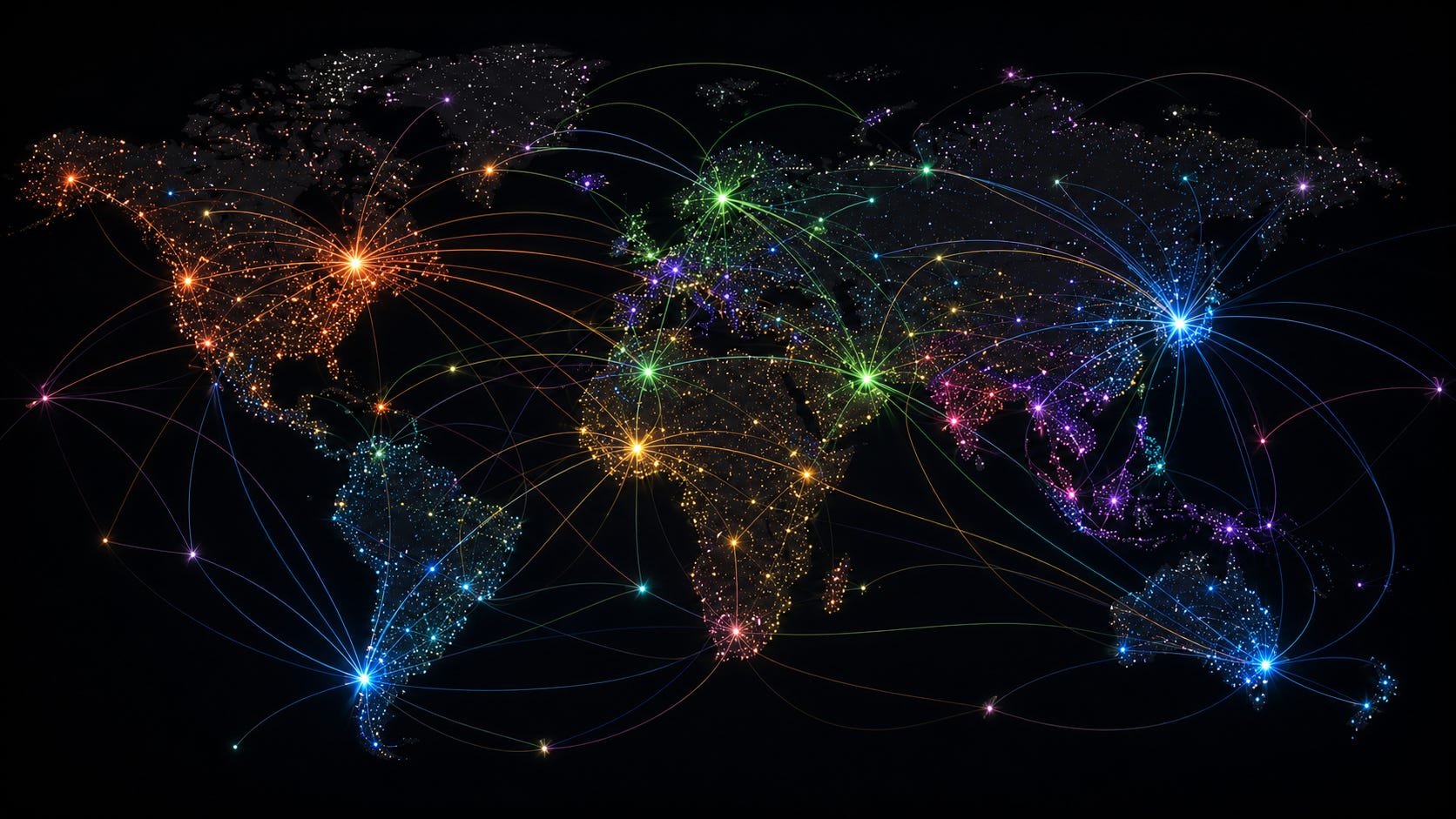
For the past seventy years, humanity has been converging. Same brands. Same malls. Same Netflix queue. A street in Riyadh looks like a street in Raleigh looks like a street in Rotterdam. Anglos built a global cosmopolitan monoculture around consumerism and exported it to every corner of the planet.
It worked. Spectacularly.
And now it’s falling apart.
Everywhere Is Nowhere
The global monoculture succeeded beyond anyone’s imagination. McDonald’s operates in 100+ countries and feeds 1% of the world every day. Instagram has 2 billion monthly users. English is the lingua franca of business, science, and entertainment. Kids in Bangladesh who’ve never set foot in a school speak English in an American accent because they’ve consumed so much mono-culture youtube. For the first time in human history, a teenager in Lagos and a teenager in London consume substantially the same cultural diet.
But when everywhere looks the same, nowhere feels like home.
Frank Wright, a British reporter, captured this in a street interview that went viral in May 2026, 40 million people watched it. Wright described England as having become “a borderless international supermarket populated by strangers who are hostile to one another.” He said he’d “rather live in a nation and not a market.”
40 million views. A nerve was struck.
The monoculture flattened everything. It gave us efficiency, optionality, and consumer choice. What it took in return was belonging. The mall replaced the town square. The algorithm replaced the conversation. The global citizen replaced the neighbour.
People tolerated this trade-off for decades. I think the tolerance is ending.
The Splintering Is Already Happening
Here’s what the data actually shows.
32 million Discord servers exist today. 2.8 million subreddits. 70 million active Facebook Groups. The average user belongs to 8.5 different groups. 115 million YouTube channels. 3.5 million podcasts. 200+ streaming services.
These are identity structures. A 2024 Pew Research study found that 68% of internet users now prefer platforms fostering “deep, meaningful interactions” over broad social networks. People are actively choosing small and meaningful over big and meaningless. Niche over mainstream. Tribe over nation.
Here’s the weird thing that’s hard to articulate but instantly recognisable if you’ve experienced it: meeting someone who’s a deep, devoted member of a completely different online community, like a different subreddit, a different corner of the internet, is like meeting someone from a different country. Maybe more so. Because most nationalities have blurred into the same global monoculture. The person across the table from you at dinner shares your passport but inhabits a completely different reality. Meanwhile, someone 5,000 miles away who found the same obscure corner of the internet as you? They get you in ways your neighbours never will.
That’s the future.
Why Now? The Collapse of the Old Identity Structures
People don’t stop needing belonging. They just find it somewhere else.
The old structures are failing:
National identity. Only 41% of Gen Z feel proud to be American, versus 83% of the Silent Generation. Each successive generation identifies less with the nation they were born into.
Institutional trust. At historic lows across every institution measured. Government, media, church, business. The Edelman Trust Barometer shows a 30-point gap between high- and low-grievance populations globally. Gen Z trusts no institution by majority except science.
Monoculture. In 1983, the M*A*S*H finale drew 106 million viewers out of a population of 234 million. Nearly half the country watching one show. There were 3 broadcast networks. Today, broadcast TV commands less than 20% of viewership. No single piece of content commands mass attention.
The old containers of identity are draining. Nation, shared culture, institutional trust. The void they leave behind is enormous.
And the internet is filling it.
The Tribes Are Already Here
This isn’t theoretical. Let me show you what’s forming right now.
Bryan Johnson and the Don’t Die Tribe
Bryan Johnson sold Braintree Venmo to PayPal for $800 million. Then he spent millions per year trying to reverse his biological age and documented everything publicly.
The result is a full-blown tribe.
6 million followers across platforms. A Netflix documentary (Don’t Die: The Man Who Wants to Live Forever). A Don’t Die app with global meetups. A Don’t Die Summit that sold out 1,500 tickets. The Rejuvenation Olympics, a competitive leaderboard with 4,000 participants measuring who can reverse aging fastest. Blueprint raised $60 million from Kim Kardashian and the Winklevoss twins. His top-tier “Immortals” program charges $1 million per year for 3 clients.
Johnson is a tribal leader with a belief system. “Don’t Die” is a worldview. It has rituals (the protocol), a community (the app and summits), competition (the Rejuvenation Olympics), identity markers (the biomarkers), and a moral framework (longevity as civilisational purpose).
Praxis: The City-Building Tribe
Dryden Brown is 28 years old and raised $525 million to build a new city.
Praxis started as an online community, a Discord essentially. It now claims 151,068 “citizens” from 80 countries. Companies founded by Praxis members have an aggregate valuation of $1.1 trillion. 12,000 people are on a waiting list to physically relocate.
The location: Atlas, about an hour north of Santa Barbara, on Vandenberg Space Force Base. A “defence-focused spaceport city.”
Zero physical residents so far. The gap between digital citizens and actual bricks is enormous. But $525 million in committed capital is not a crazy fantasy. Coinbase’s venture arm invested in January 2025. Brian Armstrong is a believer.
Praxis is testing the question: can an online tribe become a physical city? I’m bullish.
Balaji Srinivasan: The Network State
The Network State (2022) argues that nations will increasingly be founded online first, then acquire physical territory. The progression: Network Union (online community) → Network Archipelago (scattered physical nodes) → Network State (diplomatically recognised entity).
His Network School, a residential community on an island near Singapore, started with 150 people in 2024 and expanded to 400 by mid-2025. He’s planning campuses in Miami, Dubai, and Tokyo.
Government officials from Singapore, Dubai, Abu Dhabi, El Salvador, and Palau are engaging with the concept.
These are not theoretical conversations anymore.
The Special Economic Zone Explosion
In 1975, there were 79 special economic zones across 25 countries. Today there are over 7,000 across 145+ countries. That’s an 88x increase in 50 years.
Saudi Arabia launched 4 new SEZs in 2023 offering 0% corporate tax for 50 years. The UAE has 45 free zones. 47 of 54 African countries have implemented SEZ programmes. s
These zones matter for the tribalization thesis because they provide the legal substrate for experimentation. Every new SEZ is a new set of rules. Every new set of rules is a potential attractor for a community that wants to live differently.
The network state movement is essentially arguing: take the SEZ model further. From economic autonomy to governance autonomy. From a zone to a city. From a city to a nation.
Remigration: The Involuntary Catalyst
There’s another force that could accelerate tribal formation, and it’s less comfortable to talk about.
Remigration, calling for the mass return of immigrants and their descendants to countries of origin, has moved from fringe to mainstream European politics in less than three years.
Austria’s chancellor launched “Operation Fox.” Germany’s AfD held a secret meeting in Potsdam to discuss remigration plans, exposed by journalists in January 2024. Geert Wilders in the Netherlands called for “large-scale remigration programmes” in parliament. The European Parliament approved legislation enabling offshore detention centres and two-year detention periods. The Save Europe Act, a citizens’ initiative demanding a total halt to non-European immigration, gathered 100,000 signatures in three days.
The US State Department created an “Office of Remigration” in May 2025.
Whether or not these policies are implemented at scale, the political direction is clear. And if even a fraction materialise, you’re talking about hundreds of thousands — potentially millions — of people, many second- or third-generation, who don’t really fit into their countries of origin any more either. They’re too European for where they came from and, apparently, too foreign for where they are.
Where do they go?
This is exactly the kind of dislocation that creates demand for new communities. New cities. New economic zones. New tribes. People who find themselves between worlds are precisely the people most likely to build new ones.
The heartlands those people are originally from are full of underdeveloped land and governments eager for investment. The ingredients for new charter cities, new planned communities, new economic zones are all there. The people are there. The capital is there. The legal templates exist.
This isn’t speculation for the distant future. The political machinery is already in motion.
How AI Is Accelerating Everything
I don’t think AI’s primary contribution to tribal fragmentation is leisure time. Every past automation wave increased total work rather than reducing it. I see no reason AI will be different on this front.
But AI is doing something far more powerful than freeing up time. It’s building the entire infrastructure of tribal life.
AI as Tribal Matchmaker
TikTok’s recommendation algorithm doesn’t just find content for you. It sorts you into a tribe.
The platform has generated hundreds of “-core” aesthetics that function as micro-identities: cottagecore, dark academia, goblincore, blokecore, clean girl, coquette. Each one started as a content tag and became an identity that people adopt, signal, and defend.
No two For You Pages are alike. The algorithm creates individualised reality tunnels that route people into specific communities. Research from the University of Michigan confirms that “TikTok’s unique format facilitates the rise and proliferation of diverse subcultural communities.” YouTube removed its Trending page entirely in July 2025, shifting to personalised recommendations to capture micro-trends across different fandoms.
The algorithm is the most powerful tribal matchmaker in human history. And it’s getting better every day.
AI Makes One-Person Tribal Economies Viable
The share of new startups with a solo founder jumped from 23.7% in 2019 to 36.3% in the first half of 2025. Over 48,000 solo-founded startups launched in 2025, up 140% from 2024. As of early 2026, 38% of seven-figure businesses are led by solopreneurs who replaced traditional hires with AI workflows.
Pieter Levels runs NomadList, RemoteOK, and PhotoAI generating $3-5M annually with zero employees. Danny Postma built HeadshotPro to $300K/month working solo. Dario Amodei, CEO of Anthropic, gives a 70-80% probability that a one-person billion-dollar company will happen in 2026.
When the minimum viable business can serve 100 customers instead of 10,000, you can build a business that serves exactly one tribe. A solo founder can build a product for vegan CrossFit coaches or fractional CFOs serving law firms and make it work. Each niche business reinforces the identity of its community. The product becomes tribal infrastructure.
The Tribal Taxonomy
Not all tribes are alike. Here’s what’s forming:
Creator Tribes. A leader with concentric rings: inner circle of superfans, paying members, casual followers. Economics: direct patronage via Patreon, Substack, Skool. The creator economy is $252 billion and growing at 23% annually. 207 million+ active creators worldwide. These are tribal leaders, whether they know it or not.
Mission Tribes. Organised around a shared cause rather than a person. Bryan Johnson’s Don’t Die movement. Effective Altruism. The longevity community (Vitalia, Infinita). The solarpunk movement. These tribes have the strongest binding force because the mission provides existential purpose. This is the flavour of tribe I’m most bullish on.
Professional Guilds. Organised around a craft, with mentorship hierarchies and mutual economic support. Indie Hackers. On Deck. YC alumni. CrossFit affiliate owners. The medieval guild model, reborn digitally.
Lifestyle Tribes. Organised around how you live. Digital nomads (WiFi Tribe). Van-lifers. Minimalists. Biohackers. These are the ones most likely to create physical spaces — co-living, intentional communities, popup cities.
Governance Tribes. Explicitly seeking sovereignty. Praxis. Próspera. The Network State movement. Liberland. The most ambitious category and the furthest from realisation.
Fan Tribes. Organised around shared cultural consumption. K-pop fandoms. Twitch communities. Gaming guilds. The largest tribes by raw numbers, and the ones most successfully making the leap from online to offline (VidCon, TwitchCon, comic conventions).
Diaspora Tribes. People caught between worlds, too European for where they came from, too foreign for where they are. This category is about to grow significantly if remigration policies advance.
The Business of Tribes
The emerging opportunities are:
Tribal governance tools. If thousands of communities need to make collective decisions, the tooling is primitive. DAOs proved the demand ($26-28B in treasuries) but the UX is terrible. Whoever builds simple governance for non-crypto communities wins big.
Physical space development for tribes. Co-living is $4B heading toward $30B+. But most co-living is generic — affordable housing with a communal kitchen. Purpose-built tribal spaces (a building for longevity enthusiasts, a neighbourhood for indie game developers, a co-living for climate tech founders) barely exist. The demand is clearly there. The supply isn’t.
Community-led growth infrastructure. Companies using community-led growth see 32% lower customer acquisition costs and 46% higher customer lifetime value. 24% of companies can now quantify the financial value of their community. Of those, nearly half report $1M+ in impact. But the tooling to build, measure, and scale community-led growth is fragmented.
Inter-tribal services. As tribes proliferate, they need ways to negotiate, trade, and coordinate with each other. Translation layers between tribal economies. Reputation systems that travel across communities. Dispute resolution. This market doesn’t really exist yet.
Where This Is Actually Heading
The fragmentation is real, it’s measurable, and it’s accelerating. But the timeline matters, and the shape is different from what the most enthusiastic advocates imagine.
The digital fragmentation is essentially complete. By 2035, most people under 40 in developed countries will derive more of their identity from chosen online communities than from nationality, religion, or employer. This is a straight-line extrapolation of current trends. I’d bet on it heavily.
Physical tribal spaces will grow but remain niche for the next decade. Co-living, intentional communities, and popup cities will grow from thousands to tens of thousands of participants. Not millions. Not yet. Physical space has too much friction.
One or two charter city projects will reach 10,000+ residents within 15 years. Próspera, Praxis, or something we haven’t heard of yet. The legal infrastructure (7,000+ SEZs), the capital ($525M+ for Praxis alone), and the demand are all there. But diplomatic recognition of anything resembling a network state is a 2050+ event at the earliest.
AI won’t give us leisure. It’ll give us independence. Rather than creating free time, AI will make it viable for more people to earn a living serving a niche community. The minimum viable business drops from 10,000 customers to 100. The minimum viable tribe drops from requiring a team to requiring one person with the right tools. More tribes become economically sustainable. The flywheel accelerates.
The biggest risk isn’t that this doesn’t happen. It’s that it happens unevenly. A world of self-selected tribes can easily become a world of echo chambers, gated communities, and jurisdictional arbitrage for the wealthy. Tribes for the rich. Atomisation for everyone else. The infrastructure to prevent this doesn’t exist yet.
Remigration, if it materialises at scale, will be an accelerant. Millions of people in search of belonging, with capital, skills, and no obvious home. Exactly the conditions that produce new communities, new cities, and new economic zones. The heartlands those people came from are full of underdeveloped land and governments eager for investment.
The Bottom Line
The global monoculture reached its peak. It made everywhere the same. And because everywhere is the same, people are searching for somewhere that feels like theirs.
The internet gave them the tools to find each other. AI is giving them the tools to build together, to manage communities, create culture, run micro-economies, communicate across languages, and construct shared realities.
The tribes are coming. Millions of them. Most will be digital. Some will become physical. A handful will attempt sovereignty.
The nation-states aren’t going anywhere. But they’re going to share the stage with something new; fluid, voluntary, identity-rich communities that people choose rather than inherit. Communities where you belong because you want to, not because you were born there.
For seventy years, the world converged. Now it’s diverging again. Not back to the old tribes of blood and soil. Forward, into something we haven’t seen before.
The great tribal fragmentation of humanity has begun.